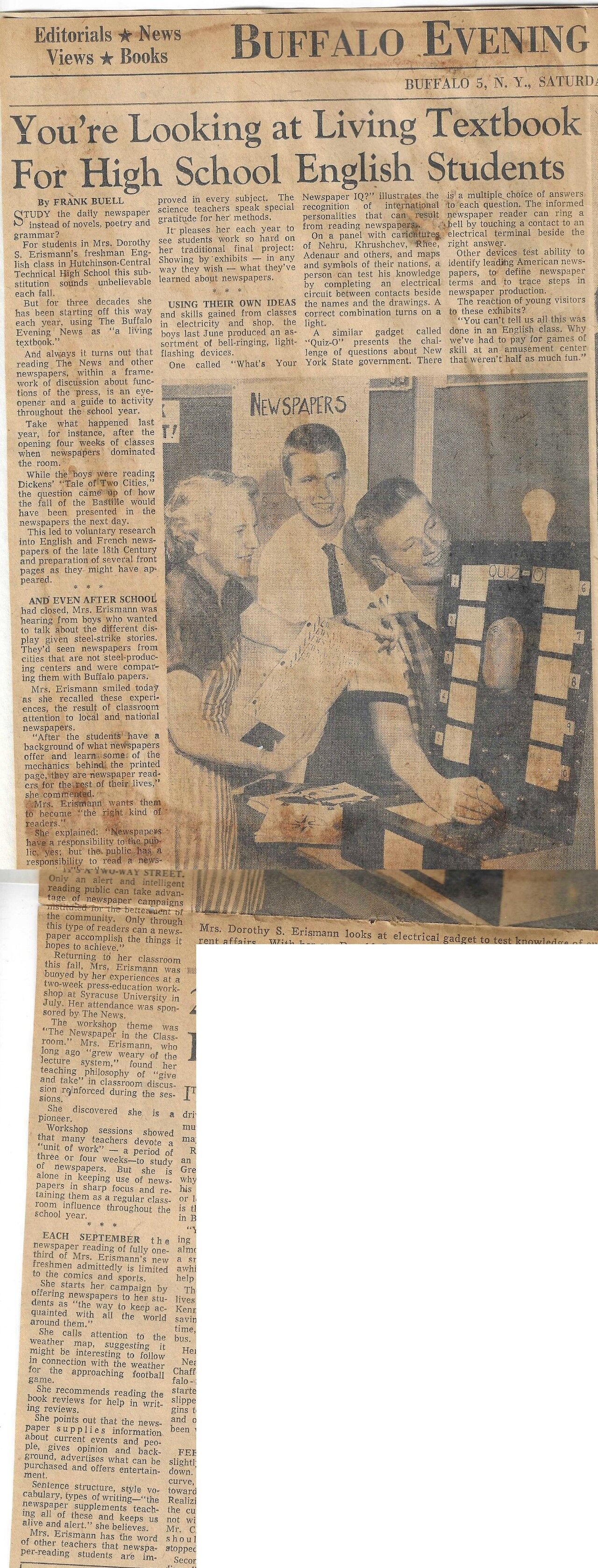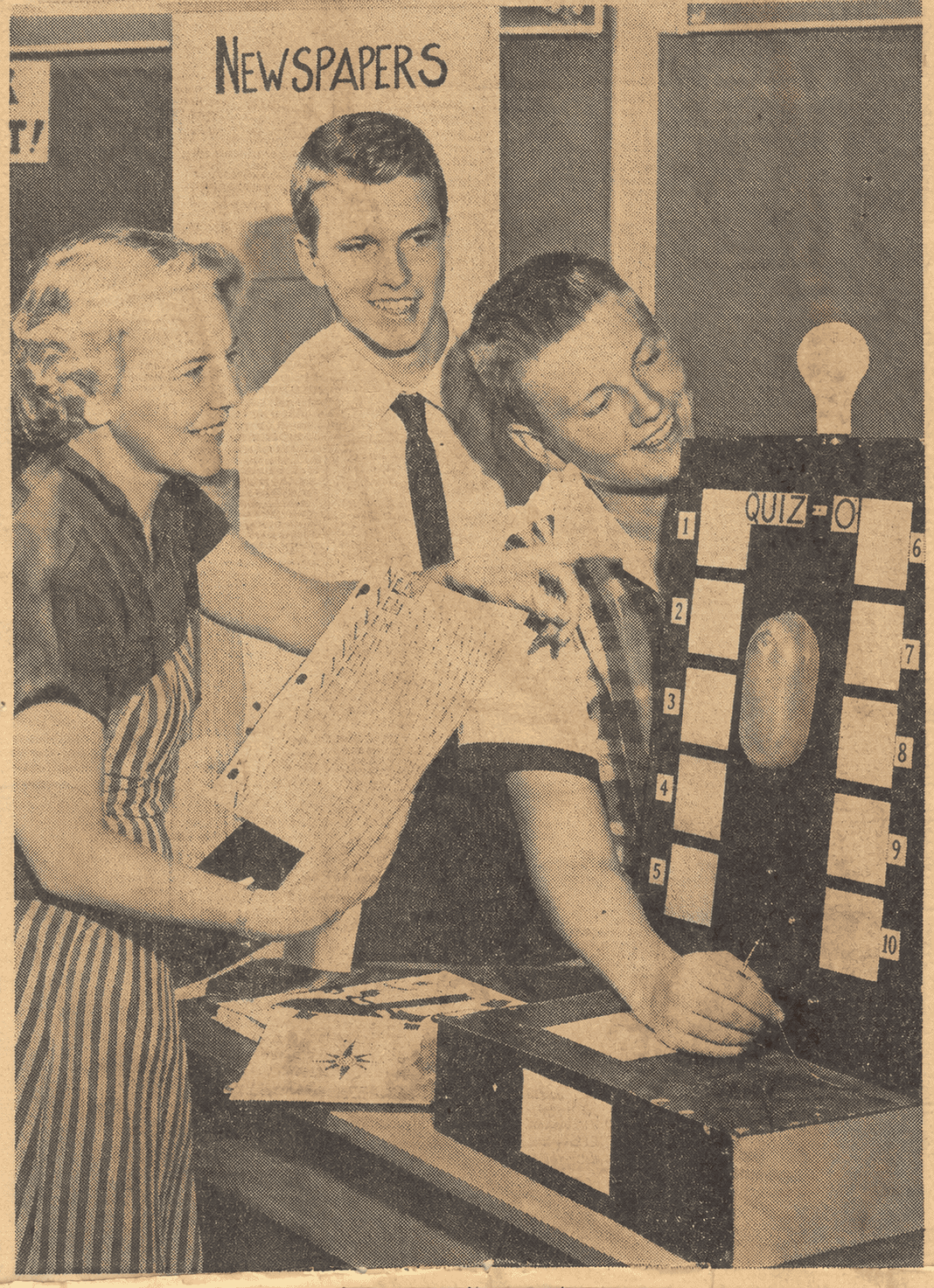
Mrs. Dorothy S. Erismann looks at electrical gadget to test knowledge of current affairs. With her are Donald Castine, 700 LaSalle Ave., center, and Ben Penner, 236 Schuele Ave. Correct answer turns on light.
STUDY the daily newspaper instead of novels, poetry and grammar?
For students in Mrs. Dorothy S. Erismann’s freshman English class in Hutchinson-Central Technical High School this substitution sounds unbelievable each fall.
But for three decades she has been starting off this way each year, using The Buffalo Evening News as “a living textbook.”
And always it turns out that reading The News and other newspapers, within a framework of discussion about functions of the press, is an eye-opener and a guide to activity throughout the school year.
Take what happened last year, for instance, after the opening four weeks of classes when newspapers dominated the room.
While the boys were reading Dickens’ “Tale of Two Cities,” the question came up of how the fall of the Bastille would have been presented in the newspapers the next day.
This led to voluntary research into English and French newspapers of the late 18th Century and preparation of several front pages as they might have appeared.
* * *
AND EVEN AFTER SCHOOL had closed, Mrs. Erismann was hearing from boys who wanted to talk about the different display given steel-strike stories. They’d seen newspapers from cities that are not steel-producing centers and were comparing them with Buffalo papers.
Mrs. Erismann smiled today as she recalled these experiences, the result of classroom attention to local and national newspapers.
“After the students have a background of what newspapers offer and learn some of the mechanics behind the printed page, they are newspaper readers for the rest of their lives,” she commented.
Mrs. Erismann wants them to become “the right kind of readers.”
She explained: “Newspapers have a responsibility to the public, yes; but the public has a responsibility to read a newspaper intelligently.
* * *
“IT’S A TWO-WAY STREET. Only an alert and intelligent reading public can take advantage of newspaper campaigns instituted for the betterment of the community. Only through this type of readers can a newspaper accomplish the things it hopes to achieve.”
Returning to her classroom this fall, Mrs. Erismann was buoyed by her experiences at a two-week press-education workshop at Syracuse University in July. Her attendance was sponsored by The News.
The workshop theme was “The Newspaper in the Classroom.” Mrs. Erismann, who long ago “grew weary of the lecture system,” found her teaching philosophy of “give and take” in classroom discussion reinforced during the sessions.
She discovered she is a pioneer.
Workshop sessions showed that many teachers devote a “unit of work” — a period of three or four weeks — to study of newspapers. But she is alone in keeping use of newspapers in sharp focus and retaining them as a regular classroom influence throughout the school year.
* * *
EACH SEPTEMBER the newspaper reading of fully one-third of Mrs. Erismann’s new freshmen admittedly is limited to the comics and sports.
She starts her campaign by offering newspapers to her students as “the way to keep acquainted with all the world around them.”
She calls attention to the weather map, suggesting it might be interesting to follow in connection with the weather for the approaching football game.
She recommends reading the book reviews for help in writing reviews.
She points out that the newspaper supplies information about current events and people, gives opinion and background, advertises what can be purchased and offers entertainment.
Sentence structure, style, vocabulary, types of writing — “the newspaper supplements teaching all of these and keeps us alive and alert,” she believes.
Mrs. Erismann has the word of other teachers that newspaper-reading students are improved in every subject. The science teachers speak special gratitude for her methods.
It pleases her each year to see students work so hard on her traditional final project: Showing by exhibits — in any way they wish — what they’ve learned about newspapers.
* * *
USING THEIR OWN IDEAS and skills gained from classes in electricity and shop, the boys last June produced an assortment of bell-ringing, light-flashing devices.
One called “What’s Your Newspaper IQ?” illustrates the recognition of international personalities that can result from reading newspapers.
On a panel with caricatures of Nehru, Khrushchev, Rhee, Adenauer and others, and maps and symbols of their nations, a person can test his knowledge by completing an electrical circuit between contacts beside the names and the drawings. A correct combination turns on a light.
A similar gadget called “Quiz-O” presents the challenge of questions about New York State government. There is a multiple choice of answers to each question. The informed newspaper reader can ring a bell by touching a contact to an electrical terminal beside the right answer.
Other devices test ability to identify leading American newspapers, to define newspaper terms and to trace steps in newspaper production.
The reaction of young visitors to these exhibits?
“You can’t tell us all this was done in an English class. Why we’ve had to pay for games of skill at an amusement center that weren’t half as much fun.”