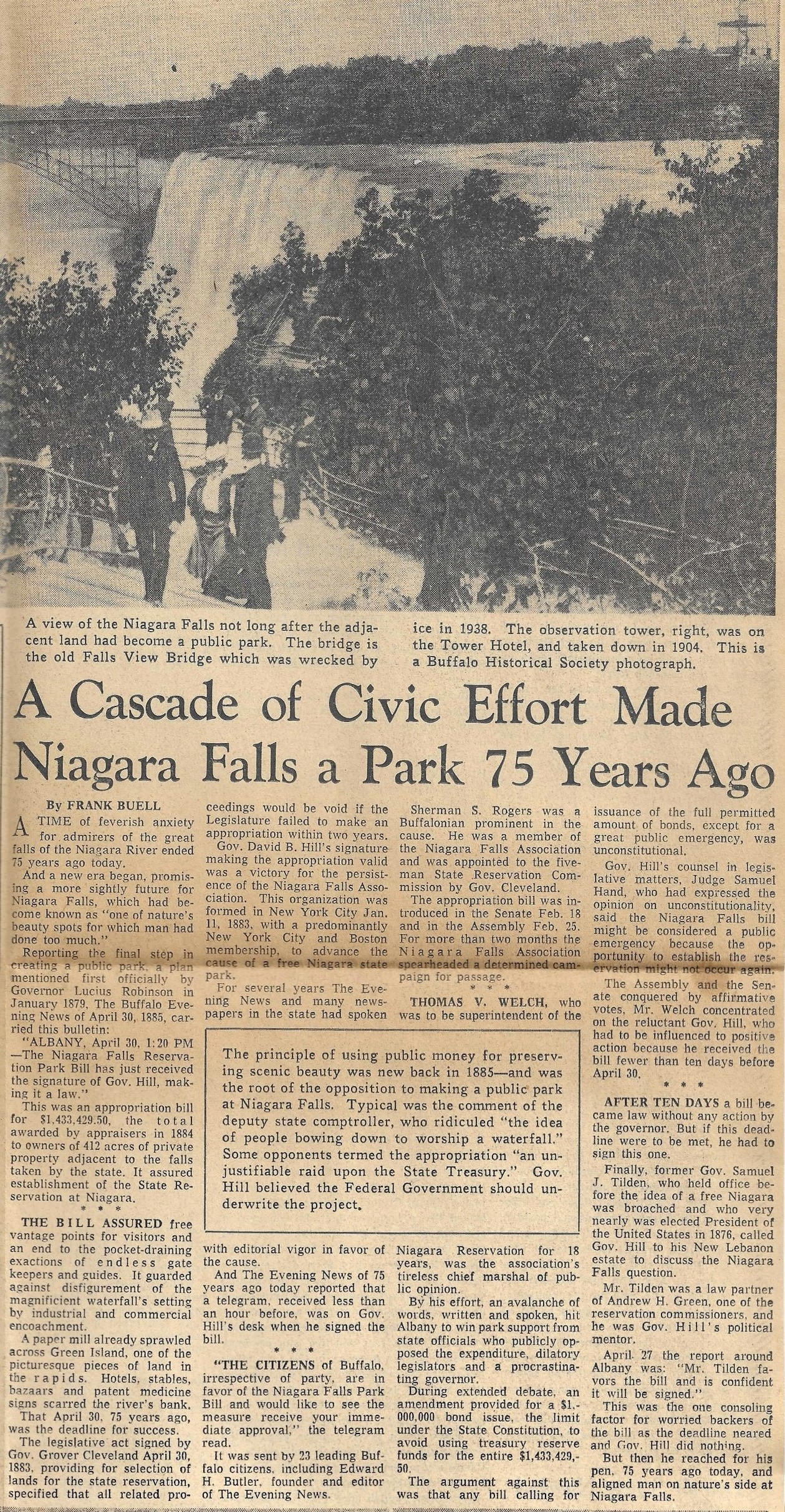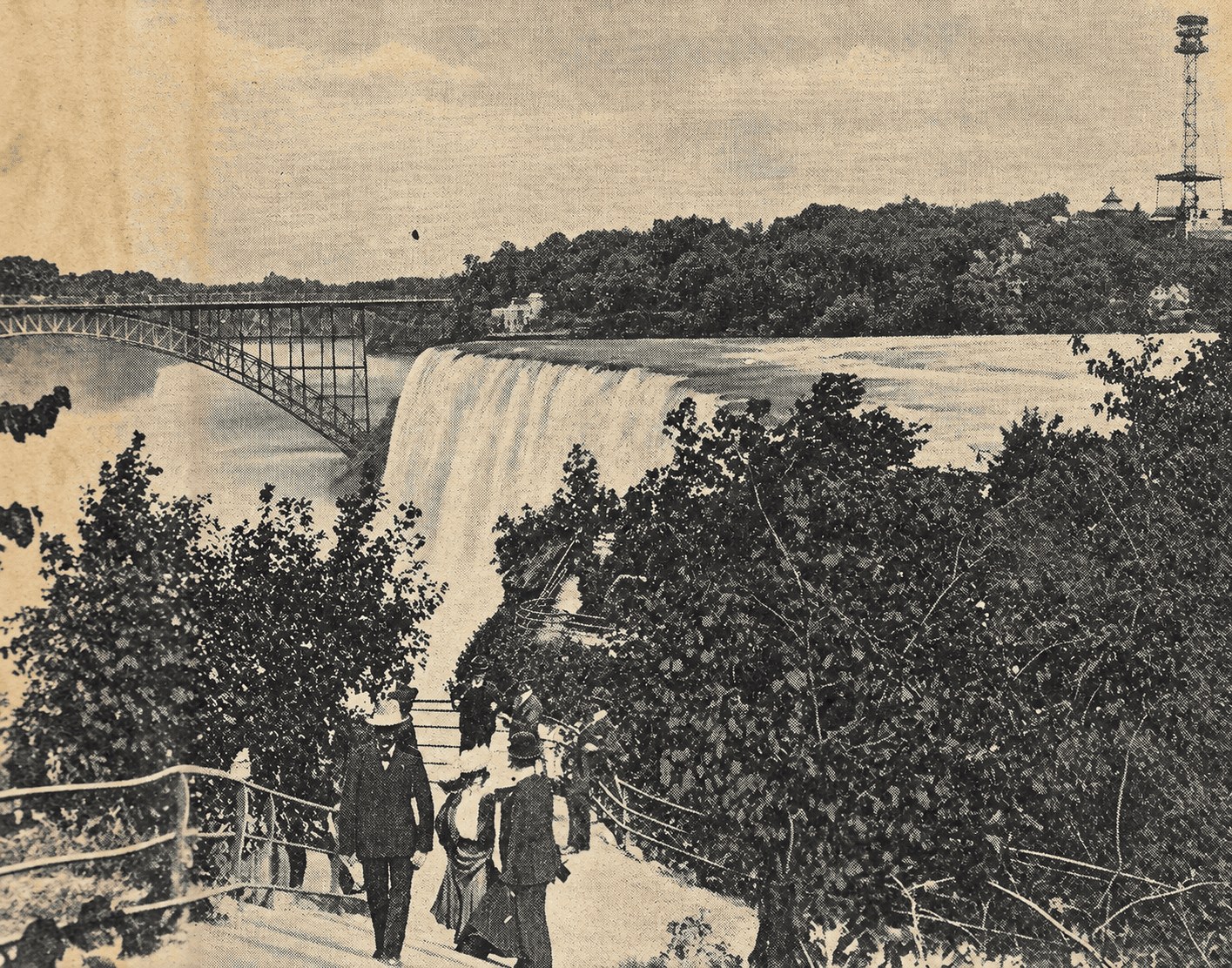
A view of the Niagara Falls not long after the adjacent land had become a public park. The bridge is the old Falls View Bridge which was wrecked by ice in 1938. The observation tower, right, was on the Tower Hotel, and taken down in 1904. This is a Buffalo Historical Society photograph.
A TIME of feverish anxiety for admirers of the great falls of the Niagara River ended 75 years ago today.
And a new era began, promising a more sightly future for Niagara Falls, which had become known as “one of nature’s beauty spots for which man had done too much.”
Reporting the final step in creating a public park, a plan mentioned first officially by Governor Lucius Robinson in January 1879, The Buffalo Evening News of April 30, 1885, carried this bulletin:
ALBANY, April 30, 1:20 PM — The Niagara Falls Reservation Park Bill has just received the signature of Gov. Hill, making it a law.
This was an appropriation bill for $1,433,429.50, the total awarded by appraisers in 1884 to owners of 412 acres of private property adjacent to the falls taken by the state. It assured establishment of the State Reservation at Niagara.
THE BILL ASSURED free vantage points for visitors and an end to the pocket-draining exactions of endless gatekeepers and guides. It guarded against disfigurement of the magnificent waterfall’s setting by industrial and commercial encoachment.
A paper mill already sprawled across Green Island, one of the picturesque pieces of land in the rapids. Hotels, stables, bazaars and patent medicine signs scarred the river’s bank.
That April 30, 75 years ago, was the deadline for success.
The legislative act signed by Gov. Grover Cleveland April 30, 1883, providing for selection of lands for the state reservation, specified that all related proceedings would be void if the Legislature failed to make an appropriation within two years.
Gov. David B. Hill’s signature making the appropriation valid was a victory for the persistence of the Niagara Falls Association. This organization was formed in New York City Jan. 11, 1883, with a predominantly New York City and Boston membership, to advance the cause of a free Niagara state park.
For several years The Evening News and many newspapers in the state had spoken with editorial vigor in favor of the cause.
And The Evening News of 75 years ago today reported that a telegram, received less than an hour before, was on Gov. Hill’s desk when he signed the bill.
“THE CITIZENS of Buffalo, irrespective of party, are in favor of the Niagara Falls Park Bill and would like to see the measure receive your immediate approval,” the telegram read.
It was sent by 23 leading Buffalo citizens, including Edward H. Butler, founder and editor of The Evening News.
Sherman S. Rogers was a Buffalonian prominent in the cause. He was a member of the Niagara Falls Association and was appointed to the five-man State Reservation Commission by Gov. Cleveland.
The appropriation bill was introduced in the Senate Feb. 18 and in the Assembly Feb. 25. For more than two months the Niagara Falls Association spearheaded a determined campaign for passage.
THOMAS V. WELCH, who was to be superintendent of the Niagara Reservation for 18 years, was the association’s tireless chief marshal of public opinion.
By his effort, an avalanche of words, written and spoken, hit Albany to win park support from state officials who publicly opposed the expenditure, dilatory legislators and a procrastinating governor.
During extended debate, an amendment provided for a $1,000,000 bond issue, the limit under the State Constitution, to avoid using treasury reserve funds for the entire $1,433,429.50.
The argument against this was that any bill calling for the issuance of the full permitted amount of bonds, except for a great public emergency, was unconstitutional.
Gov. Hill’s counsel in legislative matters, Judge Samuel Hand, who had expressed the opinion on unconstitutionality, said the Niagara Falls bill might be considered a public emergency because the opportunity to establish the reservation might not occur again.
The Assembly and the Senate conquered by affirmative votes, Mr. Welch concentrated on the reluctant Gov. Hill, who had to be influenced to positive action because he received the bill fewer than ten days before April 30.
AFTER TEN DAYS a bill became law without any action by the governor. But if this deadline were to be met, he had to sign this one.
Finally, former Gov. Samuel J. Tilden, who held office before the idea of a free Niagara was broached and who very nearly was elected President of the United States in 1876, called Gov. Hill to his New Lebanon estate to discuss the Niagara Falls question.
Mr. Tilden was a law partner of Andrew H. Green, one of the reservation commissioners, and he was Gov. Hill’s political mentor.
April 27 the report around Albany was: “Mr. Tilden favors the bill and is confident it will be signed.”
This was the one consoling factor for worried backers of the bill as the deadline neared and Gov. Hill did nothing.
But then he reached for his pen, 75 years ago today, and aligned man on nature’s side at Niagara Falls.