![Voice of Hope to Red Victims — Radio Free Europe [COVER]](https://franklynbuell.com/wp-content/uploads/radio-free-europe.png)
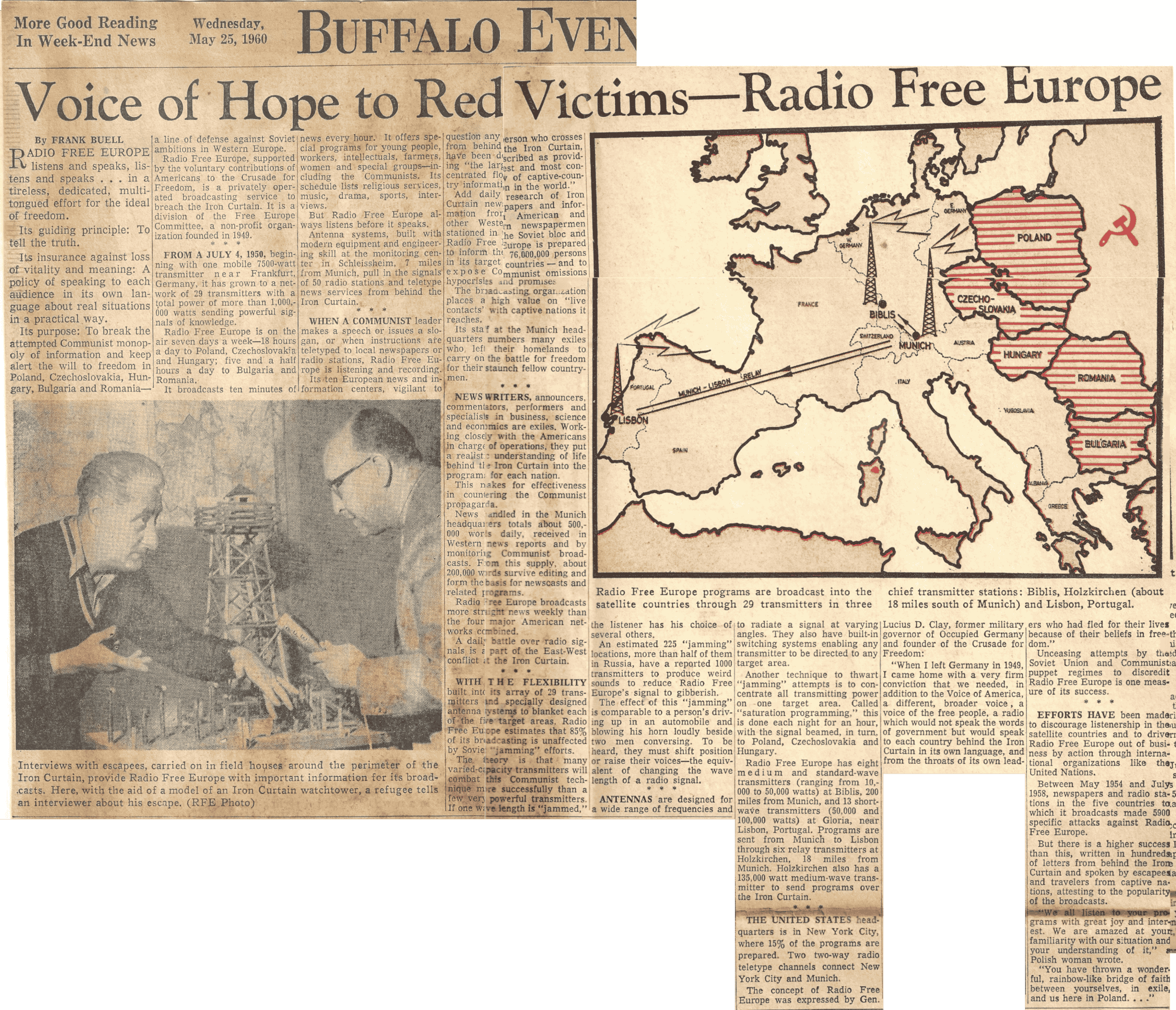
Radio Free Europe programs are broadcast into the satellite countries through 29 transmitters in three chief transmitter stations: Biblis, Holzkirchen (about 18 miles south of Munich) and Lisbon, Portugal.
RADIO FREE EUROPE listens and speaks, listens and speaks… in a tireless, dedicated, multi-tongued effort for the ideal of freedom.
Its guiding principle: To tell the truth.
Its insurance against loss of vitality and meaning: A policy of speaking to each audience in its own language about real situations in a practical way.
Its purpose: To break the attempted Communist monopoly of information and keep alert the will to freedom in Poland, Czechoslovakia, Hungary, Bulgaria and Romania—a line of defense against Soviet ambitions in Western Europe.
Radio Free Europe, supported by the voluntary contributions of Americans to the Crusade for Freedom, is a privately operated broadcasting service to breach the Iron Curtain. It is a division of the Free Europe Committee, a non-profit organization founded in 1949.
FROM A JULY 4, 1950, beginning with one mobile 7500-watt transmitter near Frankfurt, Germany, it has grown to a network of 29 transmitters with a total power of more than 1,000,000 watts sending powerful signals of knowledge.
Radio Free Europe is on the air seven days a week—18 hours a day to Poland, Czechoslovakia and Hungary; five and a half hours a day to Bulgaria and Romania.
It broadcasts ten minutes of news every hour. It offers special programs for young people, workers, intellectuals, farmers, women and special groups—including the Communist. Its schedule lists religious services, music, drama, sports, interviews.
Radio Free Europe always listens before it speaks.
Antenna systems, built with modern equipment and engineering skill at the monitoring center in Schleißheim, 7 miles from Munich, pull in the signals of 50 radio stations and teletype news services from behind the Iron Curtain.
WHEN A COMMUNIST leader makes a speech or issues a slogan, or when instructions are teletyped to local newspapers or radio stations, Radio Free Europe is listening and recording.
Its recent European news and information centers, vigilant to question any person who crosses from behind the Iron Curtain, have been described as providing “the largest and most convincing radio information in the world.”
Add daily research of Iron Curtain newspapers and information from American and other Western newspapermen stationed in the Soviet bloc and Radio Free Europe is prepared to inform the 76,000,000 persons in its target countries—and to expose Communist omissions and hypocrisies and promises.
The broadcasting organization places a high value on “live contacts” with captive nations it reaches.
Its staff at the Munich headquarters numbers many exiles who left their homelands to carry on the battle for freedom for their staunch fellow countrymen.
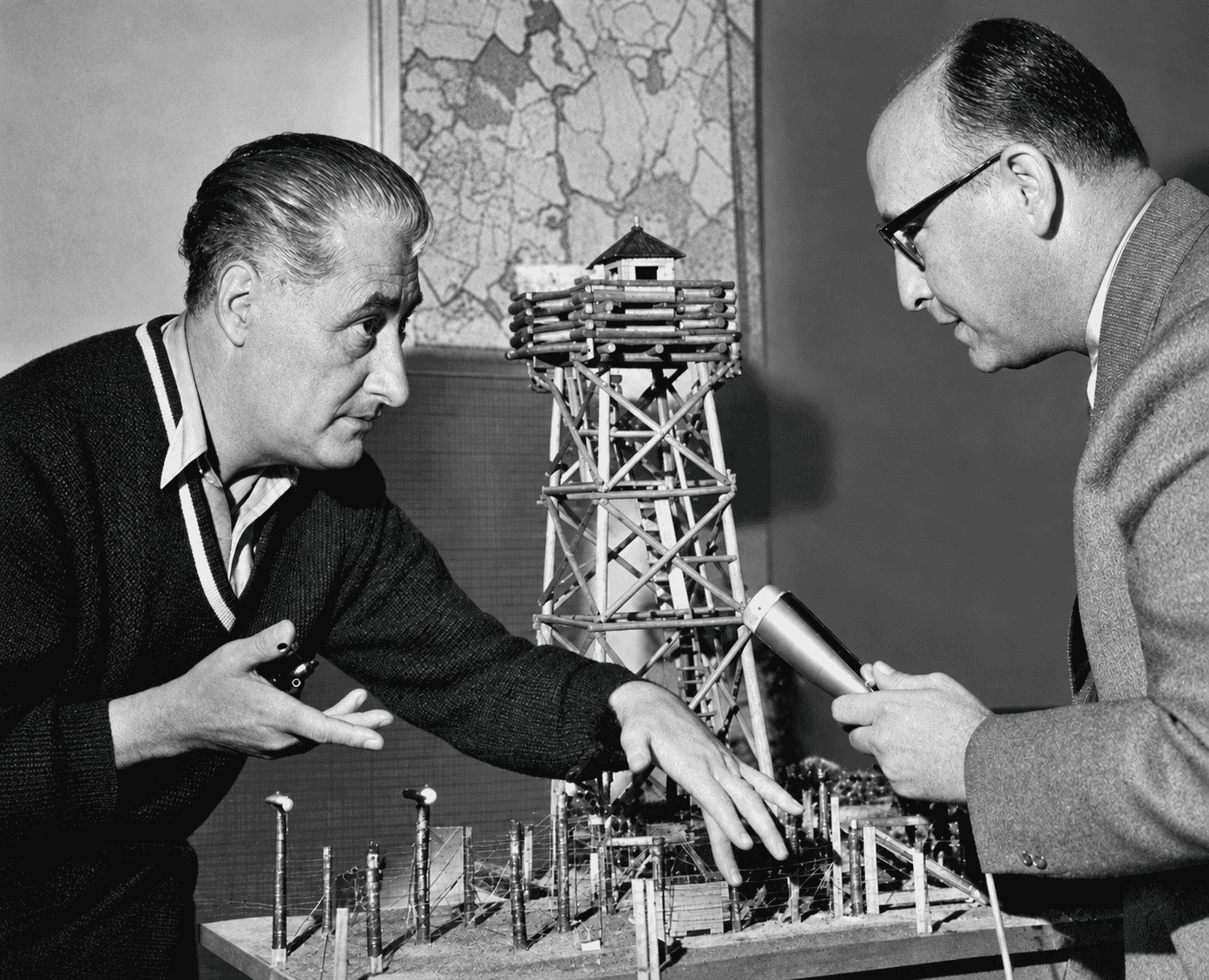
NEWS WRITERS, announcers, commentators, performers and specialists in business, science and economics are exiles. Working closely with the Americans in charge of operations, they put a realistic understanding of life behind the Iron Curtain into the programs for each audience.
This makes for effectiveness in countering the Communist propaganda.
News handled in the Munich headquarters totals about 500,000 words daily, received in Western news reports and by monitoring Communist broadcasts. From this supply, about 200,000 words survive editing and form the basis for newscasts and related programs.
Radio Free Europe broadcasts more straight news weekly than the four major American networks combined.
A daily battle over radio signals is a part of the East-West conflict at the Iron Curtain.
WITH THE FLEXIBILITY built into its array of 29 transmitters and specially designed antenna systems to blanket each of the five target areas, Radio Free Europe estimates that 85% of its broadcasting is unaffected by Soviet “jamming” efforts.
The theory is that many varied-capacity transmitters will combat this Communist technique more successfully than a few very powerful transmitters. If one wave length is “jammed,” the listener has his choice of several others.
An estimated 225 “jamming” locations, more than half of them in Russia, have a reported 1000 transmitters to produce weird sounds to reduce Radio Free Europe’s signal to gibberish.
The effect of this “jamming” is comparable to a person’s driving up in an automobile and blowing his horn loudly beside two men conversing. To be heard, they must shift position or raise their voices—the equivalent of changing the wave length of a radio signal.
ANTENNAS are designed for a wide range of frequencies and to radiate a signal at varying angles. They also have built-in switching systems enabling any transmitter to be directed to any target area.
Another technique to thwart “jamming” attempts is to concentrate all transmitting power on one target area. Called “saturation programming,” this is done each night for an hour, with the signal beamed, in turn, to Poland, Czechoslovakia and Hungary.
Radio Free Europe has eight medium and standard-wave transmitters (ranging from 10,000 to 50,000 watts) at Biblis, 20 miles from Munich, and 13 short-wave transmitters (50,000 and 100,000 watts) at Gloria, near Lisbon, Portugal. Programs are sent from Munich to Lisbon through six relay transmitters at Holzkirchen, 18 miles from Munich. Holzkirchen also has a 135,000 watt medium-wave transmitter to send programs over the Iron Curtain.
THE UNITED STATES headquarters is in New York City, where 15% of the programs are prepared. Two two-way radio teletype channels connect New York City and Munich.
The concept of Radio Free Europe was expressed by Gen. Lucius D. Clay, former military governor of Occupied Germany and founder of the Crusade for Freedom:
“When I left Germany in 1949, I came home with a very firm conviction that we needed, in addition to the Voice of America, a different, broader voice, a voice of the free people, a radio which would not speak the words of government but would speak to each country behind the Iron Curtain in its own language, and from the throats of its own leaders who had fled for their lives because of their beliefs in freedom.”
Unceasing attempts by the Soviet Union and Communist puppet regimes to discredit Radio Free Europe is one measure of its success.
EFFORTS HAVE been made to discourage listenership in the satellite countries and to drive Radio Free Europe out of business by action through international organizations like the United Nations.
Between May 1954 and July 1958, newspapers and radio stations in the five countries to which it broadcasts made 5900 specific attacks against Radio Free Europe.
But there is a higher success than this, written in hundreds of letters from behind the Iron Curtain and spoken by escapees and travelers from captive nations, attesting to the popularity of the broadcasts.
“We all listen to your programs with great joy and interest. We are amazed at your familiarity with our situation and your understanding of it,” a Polish woman wrote.
“You have thrown a wonderful, rainbow-like bridge of faith between yourselves, in exile, and us here in Poland…”